Ink, Parchment, and Power: The West African Manuscript Cities That Rewrote the Story of Medieval Knowledge
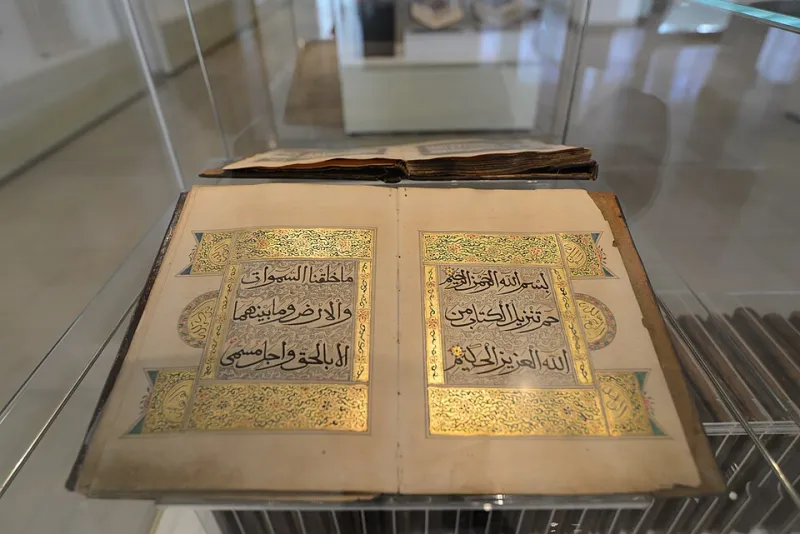
Photo: Jorge Láscar from Melbourne, Australia, CC BY 2.0, via Wikimedia Commons
A Library Hidden in Plain History
When most Americans picture the great libraries of the medieval world, they conjure images of illuminated manuscripts in Oxford or Bologna, monks bent over candlelit scriptorium tables, or the legendary ruins of Alexandria. What almost no standard history curriculum in the United States has ever taught is this: at the very same moment those European institutions were establishing themselves, the city of Timbuktu — situated in what is now Mali — was operating as one of the most intellectually dynamic centers on the planet. Scholars gathered there from across the Islamic world and sub-Saharan Africa. Booksellers lined its streets. And the manuscripts they produced, traded, and preserved number, by conservative scholarly estimates, in the hundreds of thousands.
Those texts did not vanish. Many of them still exist today. And the researchers working to recover, translate, and contextualize them are quietly dismantling one of Western education's most persistent myths: that Africa was, during the medieval period, a continent without a written intellectual tradition.
What Timbuktu Actually Was
At its height between the thirteenth and seventeenth centuries, Timbuktu was not simply a trading post on the trans-Saharan caravan route — though it was certainly that, too. It was home to the Sankore Mosque and its associated university, which at its peak enrolled somewhere between 25,000 and 30,000 students. To put that figure in context, the University of Oxford, founded in the twelfth century, had roughly 3,000 students by the mid-fifteenth century. Sankore was, by any reasonable measure, a major institution of higher learning.
The manuscripts produced and collected in Timbuktu — and in neighboring intellectual centers such as Djenné and Gao — cover a staggering range of disciplines. Surviving texts address Quranic theology and Islamic jurisprudence, but also algebra, geometry, astronomy, botany, pharmacology, political philosophy, and history. Some include marginalia indicating that they were actively used in teaching. Others bear stamps from private family libraries, revealing a culture in which book ownership was a marker of social standing and scholarly seriousness.
Estimates of how many manuscripts survive across Mali alone range from 300,000 to over a million, depending on methodology. Many remain in private family collections, passed down across generations by families who understood, even during periods of colonial disruption, that these documents represented irreplaceable patrimony.
The Crisis That Galvanized the World
For many Americans, the first time Timbuktu's manuscripts entered mainstream consciousness was in 2012 and 2013, when armed extremist groups affiliated with al-Qaeda seized northern Mali and began destroying cultural heritage sites. The destruction of ancient shrines in Timbuktu drew international condemnation. Less widely reported at the time was the extraordinary act of resistance that accompanied it: local librarians, scholars, and community members smuggled an estimated 350,000 manuscripts out of the city in secret, transporting them by donkey, boat, and foot to safety in Bamako, the Malian capital.
That act of preservation — undertaken at significant personal risk — forced a global reckoning. Institutions including the British Library, the Library of Congress, and the Andrew W. Mellon Foundation began directing resources toward digitization and conservation partnerships with Malian scholars. The Ahmed Baba Institute, Timbuktu's primary manuscript research center, has since become a focal point for international collaboration.
Yet the crisis also exposed how little institutional infrastructure existed for this work before the emergency arrived. Decades of underfunding, colonial-era indifference, and the systematic exclusion of African intellectual history from global academic canons had left these collections profoundly vulnerable.
The Scholars Doing the Work
The scholars leading manuscript recovery and translation efforts are overwhelmingly African — a fact worth emphasizing, given the historical tendency of Western institutions to position themselves as rescuers of African heritage rather than as belated partners to people who never stopped caring for it.
Researchers at the Université des Lettres et des Sciences Humaines de Bamako, alongside colleagues at institutions in Senegal, Nigeria, and Morocco, have been developing new methodologies for cataloguing manuscripts written in Arabic script but encoding content in local African languages — a practice known as Ajami writing. Ajami texts, which exist in Hausa, Fulfulde, Wolof, and dozens of other languages, represent an entire dimension of African literary culture that even many specialists had not fully accounted for.
In the United States, scholars at institutions including the University of Illinois Urbana-Champaign and Harvard's Hutchins Center for African and African American Research have contributed to translation and digitization partnerships. The Timbuktu Manuscripts Project, a collaborative effort spanning multiple continents, has made thousands of pages available online for the first time — accessible to researchers, educators, and curious readers anywhere with an internet connection.
What these scholars are finding, again and again, is not simply that the manuscripts exist, but that their content challenges foundational assumptions. A fourteenth-century text on astronomical observation methods, for instance, demonstrates computational sophistication that invites genuine comparison with contemporaneous European and Middle Eastern scholarship. Medical texts describe diagnostic procedures and herbal treatments that align, in some cases remarkably, with practices validated by modern pharmacology.
Literacy as a Western Monopoly — and the Cost of That Myth
The erasure of West African manuscript culture from global intellectual history was not accidental. Colonial administrations in French West Africa actively promoted the narrative of an illiterate, ahistorical African continent, in part because acknowledging sophisticated written traditions would have complicated the ideological justifications for conquest and extraction. That narrative shaped curricula not only in Africa but in Europe and the United States, where it persists in attenuated form to this day.
For American students and educators, confronting the Timbuktu manuscripts is not merely an exercise in filling historical gaps. It is an invitation to examine why those gaps exist — and who benefits from their continuation. An educational culture that routinely teaches Charlemagne and the Magna Carta while omitting Mansa Musa and the Sankore scholars is not simply incomplete. It is making an active interpretive choice about whose intellectual contributions deserve to be remembered.
The manuscripts offer a corrective that is both specific and sweeping. They demonstrate that literacy, scholarship, and the systematic organization of knowledge were not inventions that traveled southward from Europe or eastward from the Middle East. They were independent, parallel, and in certain respects pioneering achievements of West African civilization.
Digitization as Democratization
The ongoing effort to digitize Timbuktu's manuscripts carries significance that extends beyond academic circles. As these texts become available through open-access platforms, they enter the hands of diaspora communities in the United States, the United Kingdom, and across the Caribbean — communities for whom the existence of this intellectual tradition carries profound personal and political meaning.
For many Black Americans, whose ancestors were deliberately severed from African history as part of the machinery of enslavement, the manuscripts represent something more than historical evidence. They represent a lineage. A counter-narrative. Proof, written in ink that has survived centuries of heat, conflict, and neglect, that the people from whom they descend were not outside of civilization — but among its most dedicated architects.
The Memory Keepers of Timbuktu did not wait for the world to recognize what they held. They carried it through the desert when they had to. The question now is whether the rest of the world, and particularly American institutions of education, will finally do the work of listening.