Before the Nina, the Pinta, and the Santa María: Africa's Ancient Web of Global Commerce
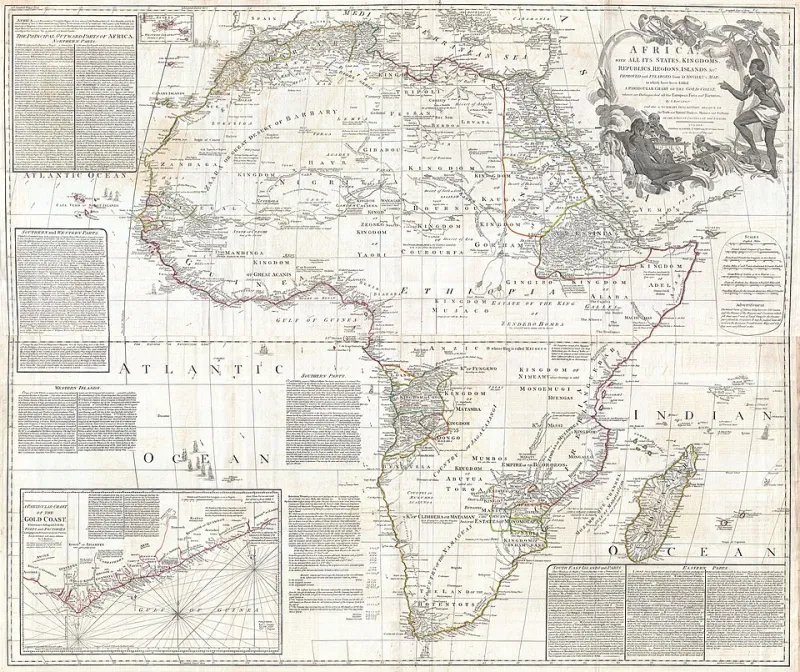
Photo: Solomon Boulton / Jean Baptiste Bourguignon d'Anville, Public domain, via Wikimedia Commons
When American schoolchildren learn about the origins of global trade, the story typically begins somewhere in fifteenth-century Europe — a Spanish monarch, a Genoese sailor, a fleet of three ships. What that narrative omits is both staggering in its scope and consequential in its implications. Long before Christopher Columbus set foot on a Caribbean island, Africa sat at the center of an intercontinental commercial system so sophisticated that its logistical complexity rivals anything the modern world has constructed. To understand world history accurately, one must first understand the African trade networks that made it possible.
The Sahara Was Never a Barrier — It Was a Highway
The popular imagination tends to picture the Sahara Desert as an impenetrable wall separating sub-Saharan Africa from the Mediterranean world. The historical record tells a profoundly different story. By at least 300 CE — and almost certainly earlier — Berber-speaking traders known as the Garamantes had engineered an elaborate system of underground aqueducts and established caravan routes that sliced through the desert with remarkable efficiency. Their successors, including Tuareg and Arab merchants, refined these corridors into arteries of commerce that pulsed with extraordinary regularity.
Gold from the Ghana Empire, salt extracted from the Saharan mines of Taghaza, kola nuts, enslaved persons, ivory, and textiles all moved northward toward the ports of Carthage, Tripoli, and Alexandria. In return, copper, horses, glassware, and manuscripts flowed southward into the heart of the continent. The Mali Empire — which, at its fourteenth-century peak under Mansa Musa, controlled more gold than perhaps any other polity on earth — was not simply a passive supplier of raw materials. It was an active participant in a multilateral exchange system that set prices, established standards of measurement, and enforced contractual norms across thousands of miles.
The intellectual traffic along these routes was equally significant. The city of Timbuktu, situated at the intersection of Saharan caravan paths and the Niger River, accumulated a library of nearly one million manuscripts by the fifteenth century. Scholars from Cairo, Baghdad, and Andalusia traveled there not merely to trade but to study. The university at Sankore predates Oxford by at least two centuries. Commerce and knowledge moved together, inseparable.
The Indian Ocean: Africa's Eastern Frontier of Exchange
If the trans-Saharan routes represent Africa's northern commercial axis, the Indian Ocean trade network constitutes its eastern dimension — and it is here that the sheer antiquity of African global engagement becomes most apparent. The monsoon wind system, which reverses direction seasonally, effectively created a natural engine for maritime trade. African, Arab, Persian, and Indian sailors understood this system intimately and exploited it for millennia.
The Swahili Coast — stretching from present-day Somalia through Kenya, Tanzania, and Mozambique — was not a peripheral zone of the ancient world. It was one of its most dynamic commercial frontiers. City-states such as Kilwa, Mombasa, and Malindi operated as sophisticated entrepôts where African iron, gold from the Zimbabwe Plateau, and enslaved laborers were exchanged for Chinese porcelain, Indian cotton, and Persian glassware. Kilwa, in particular, struck its own gold coinage by the thirteenth century — a marker of economic confidence and administrative maturity that demands serious scholarly attention.
When the Chinese admiral Zheng He led his famous treasure fleets into the Indian Ocean between 1405 and 1433, he was not arriving at an undiscovered frontier. He was entering a commercial ecosystem that East African merchants had helped build and sustain for centuries. The giraffe he famously brought back to the Ming court as a diplomatic gift traveled from Malindi — a Swahili city that was already conducting regular business with China through well-established intermediary networks.
The Mediterranean Dimension: Africa as Intellectual and Commercial Peer
North Africa's relationship with the Mediterranean world is perhaps the most consistently misunderstood dimension of African commercial history. Egypt's role as a granary, a financial center, and an intellectual hub for the ancient Mediterranean world is well documented but rarely framed as an African contribution. Carthage — the North African city-state that Rome feared above all others — commanded a maritime trading empire stretching from the Levant to the Iberian Peninsula before Rome destroyed it in 146 BCE.
Later, under Islamic governance, cities like Cairo and Kairouan became nodes in a Mediterranean commercial network that circulated spices, textiles, paper, and philosophical texts across what historian S. D. Goitein famously documented through the Cairo Geniza — a cache of nearly 300,000 manuscript fragments that illuminate a vibrant, Africa-centered mercantile culture operating across three continents simultaneously.
Why This History Was Buried — and Why Recovering It Matters
The deliberate marginalization of Africa's commercial history served specific ideological purposes. The transatlantic slave trade required a narrative in which Africans were objects of commerce rather than its architects. Colonial economic systems depended on the fiction that Africans lacked the institutional capacity for complex trade. These narratives were constructed, not discovered, and they have distorted both academic scholarship and popular understanding for generations.
For American audiences, the stakes of this correction are particularly high. The United States economy is deeply entangled with African markets, African resources, and the African diaspora's intellectual and cultural contributions. Recognizing Africa's historical centrality to global commerce is not a gesture of charity — it is a prerequisite for an accurate understanding of how the modern world was actually built.
The routes that carried gold from Mali to Morocco, iron from the Great Lakes to the Swahili Coast, and ideas from Timbuktu to Toledo did not vanish when European powers began asserting dominance over global trade. They were suppressed, rerouted, and written out of the dominant historical record. Restoring them to their proper place is among the most important intellectual projects of our time.
At Kradjabeba, we believe that uncovering Africa's stories is inseparable from shaping a more honest and equitable future. The invisible network was never truly invisible — it was simply ignored by those who had reasons to look away.