Voices That Outlast Stone: The Living Archive Keepers Redefining What History Means
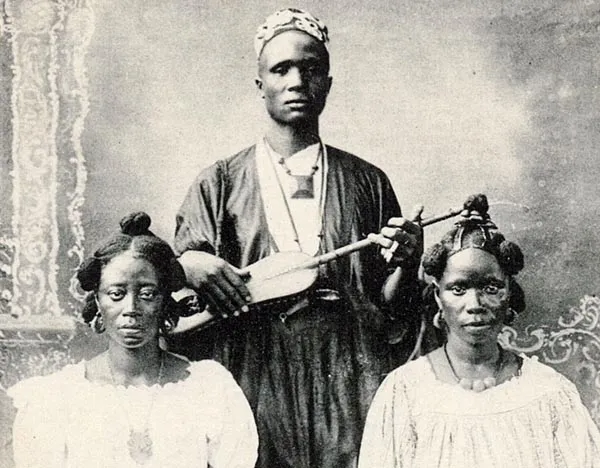
Photo: unknown photographer, c. 1910., Public domain, via Wikimedia Commons
When the Malian city of Timbuktu captured global headlines during the 2012 crisis over its endangered manuscripts, the world's attention fixed almost entirely on paper — on the fragile, centuries-old folios being smuggled to safety in footlockers and beneath market stalls. What that narrative largely missed was an equally endangered, equally sophisticated body of knowledge that has never been written down at all. It lives, instead, in the trained minds and disciplined voices of the men and women whose profession is memory itself.
These practitioners — known most widely by the Mande term griot, though they carry dozens of names across the continent — are not simply storytellers in the casual sense Americans might imagine. They are professional historians, genealogists, jurists, and diplomatic intermediaries whose training begins in childhood and whose accuracy is enforced by the communities that depend on them. Understanding their methods, and the sophisticated epistemologies behind them, demands that we seriously interrogate assumptions about historical reliability that most Western institutions have long taken for granted.
A Discipline, Not a Tradition
The word "tradition" can mislead. It implies something inherited passively, practiced out of habit. What griots and their equivalents across the continent — the jeli of the Mandinka, the imbongi of the Zulu, the arokin of the Yoruba — do is better described as a rigorous discipline with its own internal standards of verification and transmission.
In many lineages, apprentice oral historians spend years learning not only the content of their community's records but the structural devices that encode accuracy into the recitation itself. Genealogies are nested within historical narratives; historical narratives are anchored to verifiable astronomical or agricultural events; and the whole is cross-referenced against the accounts of neighboring lineages. The system is deliberately redundant. Where a single written document can be lost, forged, or misread, an oral record distributed across multiple trained practitioners and checked against community memory creates a form of distributed verification that some archival theorists now find genuinely impressive.
Dr. Mamadou Diawara, a historian at Goethe University Frankfurt who has spent decades studying West African oral archives, has argued that the dismissal of these systems as unreliable reflects a category error. "We were trained to ask whether oral sources could be as reliable as written ones," he has noted. "The better question is whether they are reliable differently — and by their own standards, many of them are extraordinarily reliable indeed."
What the Archive Cannot Hold
There is a category of knowledge, however, that goes beyond what any archive — oral or written — is designed to capture. Oral historians in many African communities carry what might be called relational knowledge: the living context of why a particular boundary was drawn, why a particular alliance was sealed, why a particular name carries weight or shame across generations. This is not sentiment. In communities where land rights, inheritance disputes, and diplomatic relationships are still adjudicated in part through historical precedent, this knowledge has immediate, material consequences.
In the Sahel, for instance, oral historians have testified in land tenure disputes where no written deed exists — and their testimony has been admitted as evidence in both traditional and, increasingly, formal legal proceedings. In parts of Uganda and Rwanda, oral genealogists have been consulted during post-conflict reconciliation processes to establish community relationships that paper records could not reconstruct. The knowledge is not merely cultural. It is infrastructural.
This is precisely what makes the current moment both urgent and promising. The practitioners who carry this knowledge are aging. The apprenticeship pipelines that once reliably reproduced these skills have been disrupted by urbanization, by the displacement of indigenous languages in formal education, and by economic pressures that make a decade of unpaid apprenticeship prohibitive for young people. The window for preservation is narrowing.
Digital Partnerships and the Question of Consent
Over the past decade, a growing number of initiatives have sought to address this urgency through technology. Projects affiliated with institutions including the British Library's Endangered Archives Programme, the Smithsonian's Center for Folklife and Cultural Heritage, and various African universities have funded field recordings, transcriptions, and digital repositories of oral historical material. The results have been genuinely significant — thousands of hours of recitation preserved in formats that will outlast their speakers.
But the more thoughtful practitioners in this space are quick to acknowledge the complications. Recording a griot's recitation is not the same as preserving the knowledge system that produced it. Without the training, the community context, and the living relationships of verification, a digital file is, at best, a partial record. It captures the output of the system without capturing the system itself.
There are also serious questions of intellectual property and community sovereignty. In several documented cases, oral historical material recorded by outside researchers has been deposited in foreign institutional archives without meaningful ongoing access for the communities of origin. The Mukurtu platform, developed in part to address exactly this problem, allows communities to set their own access protocols for digitized cultural material — a model that several African oral history projects have now adopted. The principle is straightforward but radical: the community that produces the knowledge retains authority over who encounters it and how.
Some of the most promising current work sidesteps the extraction model entirely. Initiatives like the Griot Network Project, which supports inter-community exchanges among oral historians across West Africa, focus on strengthening the transmission systems themselves rather than simply archiving their outputs. The goal is not a museum of memory but a living practice.
Rewriting the Evidentiary Standard
For American audiences accustomed to a historical culture that privileges the document — the signed treaty, the census record, the newspaper account — the implications of taking oral archives seriously are genuinely far-reaching. It means acknowledging that significant portions of African history, including pre-colonial political structures, trade relationships, and scientific knowledge, have been systematically underweighted in global historiography not because the evidence was absent but because the evidence was in a form that Western institutions were not trained to read.
This is not a minor methodological adjustment. It is a reconsideration of whose knowledge has been counted as knowledge at all.
The oral historians of the African continent have been keeping records through famine, war, colonization, and displacement. Their methods have been tested by centuries of precisely the kind of adversity that destroys paper archives. That their work is only now receiving sustained academic attention says more about the institutions doing the evaluating than about the quality of what is being evaluated.
The voices that outlast stone are still speaking. The discipline now is learning, finally, to listen with appropriate rigor.