Whose Museum Is It Anyway? The Benin Bronzes and America's Reckoning With Its Own Galleries
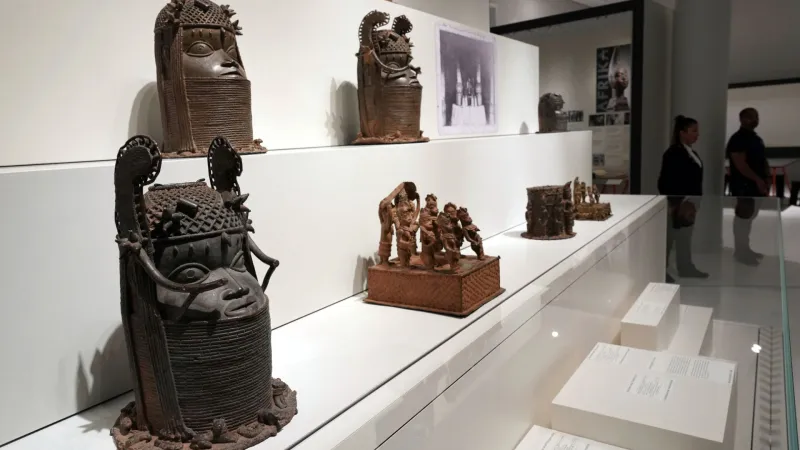
Photo: Benin bronze plaques museum display African art, via africanscolumn.com
In the basement storage of a New England university museum sits a brass plaque depicting a Portuguese trader, cast in the Kingdom of Benin sometime in the sixteenth century. It has not been displayed in a decade. Few students know it exists. Fewer still know how it arrived in the United States — sold, resold, and donated through chains of transaction that begin with a British punitive expedition in 1897 that burned Benin City, killed an unknown number of people, and carried off thousands of artworks.
That plaque is one small piece of a much larger reckoning now underway across American cultural life.
How the Loot Reached American Shores
When British forces sacked Benin City, the bronzes and ivories they seized were auctioned to pay for the expedition itself — a detail that still stings scholars today. Buyers across Europe resold works to collectors, and by the early twentieth century, American museums and private hands had become some of the most significant holders of Benin material outside Europe.
The Metropolitan Museum of Art, the Field Museum in Chicago, the Peabody museums in Massachusetts, and numerous university collections all came to hold objects from the 1897 dispersal. Their acquisition paperwork, when it exists at all, often describes gifts from benefactors whose fortunes were built in eras when African art was treated as trophy rather than heritage.
A Shift in the Ground Beneath the Galleries
For decades, the standard institutional response to restitution requests followed a familiar script: legal title was clear, statutes of limitations had run, and objects were 'safer' in Western institutions. That script has visibly frayed.
The Smithsonian's National Museum of African Art announced in 2022 that it would return 29 Benin bronzes to Nigeria — a decision made under the institution's new ethical returns policy, which allows deaccessioning based on moral considerations rather than narrow legal technicalities. Universities from Rhode Island to the District of Columbia have followed with their own transfers. Germany's agreement to transfer ownership of more than a thousand Benin objects raised the stakes considerably, making American hesitation harder to defend.
Scholars of Nigerian descent, including the late artist and historian Ben Enwonwu's heirs and a generation of Nigerian-American academics, have argued that the bronzes are not merely art objects but primary historical documents — court records cast in metal, made by guilds whose techniques were passed through hereditary lineages.
The Case for Restitution, and the Complications
Advocates for return make a straightforward argument: objects seized in a military raid have no legitimate claim to permanent residence abroad, and the institutions holding them derive ongoing prestige, scholarship, and revenue from that seizure.
Critics raise practical concerns — political instability, conservation capacity, the sheer number of claimant institutions in Nigeria itself. But these objections have aged poorly. The planned Edo Museum of West African Art in Benin City, designed by Ghanaian-British architect David Adjaye, represents a serious institutional homecoming effort. Nigerian archaeologists, conservators, and curators have managed their own heritage for decades.
What Americans Lose and Gain
Some museumgoers worry that restitution means empty vitrines. The more likely outcome is different: long-term loans, shared stewardship agreements, digital access to collections, and — most importantly — exhibitions curated in partnership with Nigerian scholars rather than about them.
The deeper loss, in fact, has already occurred. For a century, Americans have encountered the Kingdom of Benin primarily through the story of its plunder, with its art stripped of the courtly, religious, and diplomatic contexts that gave it meaning. Restitution does not erase African history from American museums. Done well, it is the first honest chapter of it.