Around One Fire: The African Communal Kitchen Tradition America Is Only Now Discovering
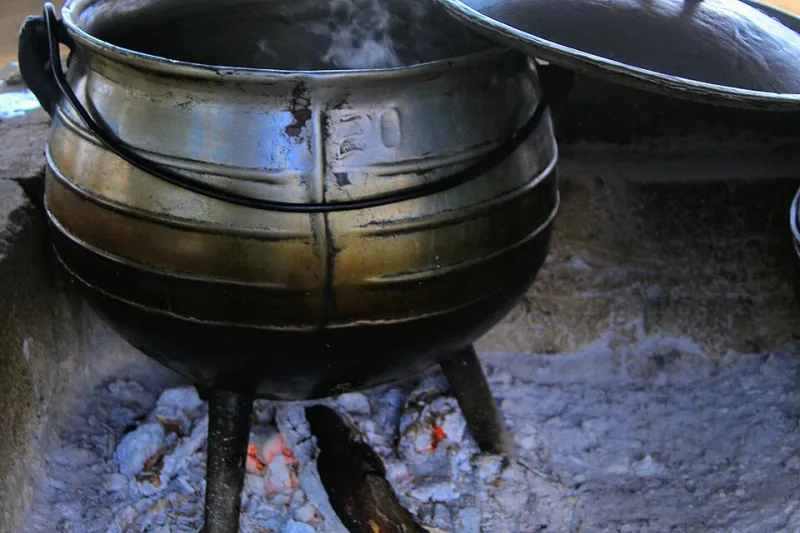
Photo: Jay Superthato, CC0, via Wikimedia Commons
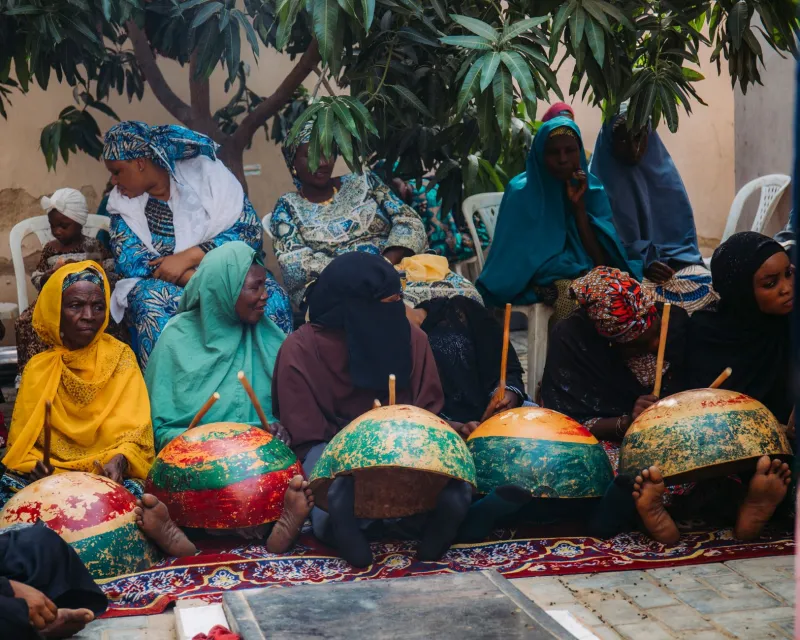
There is a moment, familiar to anyone who has spent an evening at a West African communal meal, when the cooking stops being preparation and becomes performance. Elders direct the fire. Younger relatives stir, taste, and argue about seasoning. Neighbors drift over with contributions nobody asked for but nobody refuses. By the time the food is served, the meal has already accomplished its real work: it has assembled a community.
American food culture, after decades of optimization, is in the middle of an awkward reckoning with what it lost along the way. Meal kits delivered in insulated boxes. Solo dinners eaten over sinks. Restaurants designed for turnover rather than lingering. Into this landscape, a quieter counter-current has been building, and its sources run deep into African history.
The Fire That Crossed the Atlantic
Ask a pitmaster in Memphis or the Carolinas about the origins of American barbecue, and the honest answer leads back to West and Central Africa. Enslaved Africans carried with them sophisticated traditions of slow-smoking meat over wood fires, of seasoning with chiles and seeds, of cooking communally for large gatherings. Historians of Southern foodways have documented how techniques preserved in African American communities became the foundation of what America now markets as its singular native cuisine.
What is less often acknowledged is that the social architecture of the cookout traveled alongside the techniques. In many African societies, the shared fire was a civic institution. Cooking for a large group was not a burden assigned to one household but a distributed obligation that bound extended families and neighborhoods together. The American cookout, at its best, is a fossil of that system.
The Loneliness Data
The statistics confronting American social life are by now grimly familiar. Surgeon General advisories have framed loneliness as a public health crisis. Surveys consistently show that shared family meals are declining, and that adults increasingly report eating alone. Food waste, meanwhile, remains staggering: roughly a third of the American food supply is discarded, much of it at the household level.
African communal eating traditions address both problems simultaneously, because they were engineered in environments where waste was costly and social cohesion was survival. Large-pot cooking, shared platters, and the practice of eating in sequence from a common source minimize waste by design. And because the meal is a collective event rather than an individual transaction, the labor and the food itself circulate through the community.
The New Communal Kitchens
Across the United States, the model is being rediscovered in deliberately modern forms. Community kitchens in cities like Atlanta, Oakland, and Philadelphia operate on principles that would be recognizable in an Accra courtyard: pooled ingredients, shared labor, meals that scale to whoever shows up. Neighborhood dinner clubs organized by diaspora chefs are introducing Americans to the Ethiopian practice of eating from a shared platter of injera, or the Senegalese tradition of teranga, a hospitality ethic in which feeding guests is a matter of honor.
Restaurateurs, too, are experimenting. Open-fire restaurants drawing explicitly on African techniques have appeared in New York, Los Angeles, and Chicago, and menus built around shared platters and communal portions are increasingly treated not as novelty but as a serious answer to the transactional feel of contemporary dining.
What the Fire Actually Builds
Skeptics might dismiss all of this as dining trends with good marketing. But the research on shared meals suggests the stakes are real. Studies on family dining link regular shared meals to improved outcomes for children. Sociologists studying food-sharing networks find they correlate with stronger mutual-aid capacity in neighborhoods. The African traditions arriving in American kitchens were never just about flavor; they were technologies of trust.
That is the deeper lesson of the communal fire. A society that eats alone, cooks alone, and discards what it cannot consume alone is not merely inefficient. It is practicing, meal by meal, the architecture of isolation. The African foodways now reshaping American kitchens propose a different architecture, one where the fire is lit in the middle of the gathering, and the gathering is the point.