Counters of Seeds and Centuries: The Ancient African Board Games Conquering American Tabletops
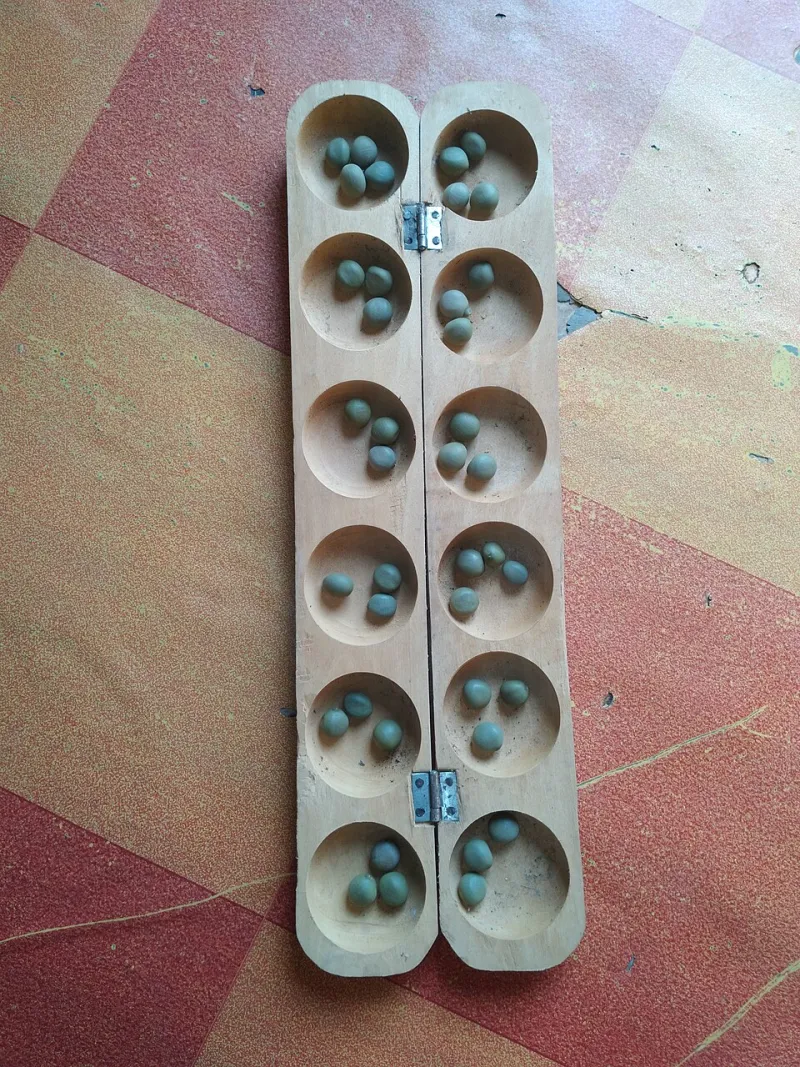
Photo: Professor M A A, CC BY-SA 4.0, via Wikimedia Commons
Somewhere in an American living room right now, a child is sliding stones across a wooden board with two rows of pits, learning arithmetic without realizing it, and playing a game older than the printing press, older than chess's spread through Europe, older in some forms than the Roman Empire. The mancala family of games, born in Africa and refined across millennia, is quietly having a moment in the United States.
The renaissance is driven by forces easy to recognize: parental anxiety about screens, the boom in homeschooling, the explosion of indie tabletop gaming, and a growing appetite for games with genuine history. Here are seven African games worth knowing, and the stories they carry.
1. Oware (Ghana and Beyond)
The most widely played member of the mancala family, oware is a two-row game of sowing and capturing seeds, governed by elegant rules that produce surprising depth. Played across West Africa for centuries, often by elders at twilight, it has become a staple of American classrooms as a hands-on tool for teaching counting, probability, and strategic planning. The Ashanti proverb associated with it, that the game reveals character, remains accurate after a single competitive round.
2. Ayo (Nigeria)
The Yoruba variant of the mancala family, ayo is played with the same board concept but distinct capture rules that shift its strategy considerably. Ayo tournaments remain popular in Nigeria, and Nigerian diaspora communities have carried the game into American cities, where it now appears in cultural festivals and independent game cafés.
3. Gebeta (Ethiopia and Eritrea)
Ethiopia's mancala tradition, gebeta, is among the oldest continuously played games in the world, with roots reaching toward the ancient Aksumite kingdom. Its association with Ethiopian and Eritrean restaurants in the United States has made it a natural ambassador: many Americans first encounter it over coffee, following a meal, exactly as intended.
4. Senet (Ancient Egypt)
The granddaddy of them all. Senet, played in Egypt as early as 3100 BCE, is one of humanity's oldest attested board games, its boards found in tombs including that of Tutankhamun. Modern replicas and faithful reconstructions have become favorites among American history enthusiasts and museum shops, and its blend of luck and strategy makes it genuinely playable, not just decorative.
5. Shisima (Kenya)
A fast, elegant alignment game from the Lake Victoria region, shisima is often described as Africa's answer to tic-tac-toe, but with a mobile central piece that gives it far more life. Its quick setup and simple rules have made it a favorite of American homeschool curricula and occupational therapists alike.
6. Morabaraba (Southern Africa)
A three-in-a-row capture game played by the Sotho and Xhosa peoples, morabaraba is now a recognized competitive sport in South Africa, with formal tournaments and federations. Its American following is smaller but devoted, particularly among fans of abstract strategy games in the tradition of chess and Go.
7. Seega (Egypt)
A capture game played across North Africa with deep strategic roots, seega rounds out the list for players who want something chess-adjacent without the learning curve. Its ancient pedigree, attested in Egyptian archaeological finds, makes it a favorite for museum education programs.
Why the Old Games Win
What unites these games is not nostalgia but design. The mancala family in particular teaches number sense, resource management, and forward planning in a form so tactile that children absorb the math before they name it. In an era when American parents are actively searching for alternatives to screens, a carved board and a handful of seeds offer something an app cannot: physicality, presence, and a connection to a game someone's grandmother played, and her grandmother before her.
The tabletop renaissance in America has room for games from everywhere. But few carry the depth of history, the mathematical elegance, and the sheer staying power of Africa's board game traditions. The seeds have been sown for millennia. They are sprouting again, one living room at a time.