Before the Aqueduct: What the Sahara's Ancient Water Engineers Know That the American Southwest Is Learning the Hard Way
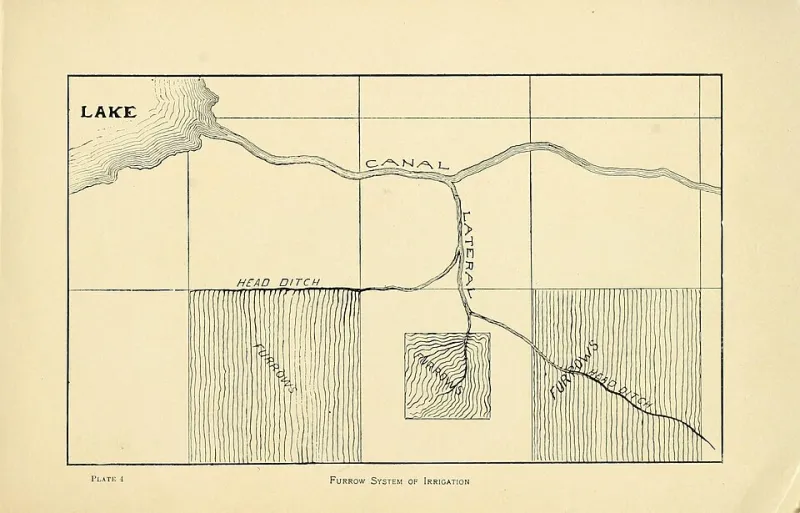
Photo: Internet Archive Book Images, No restrictions, via Wikimedia Commons
The numbers coming out of the American Southwest read like a slow-motion emergency. Lake Mead at historic lows. Seven states locked in negotiations over a Colorado River that no longer contains the water their compacts promised. Lawns torn out in Los Angeles while alfalfa fields in the desert consume trillions of gallons.
Now a growing number of hydrologists and community planners are asking an uncomfortable question: what if the answer isn't bigger engineering, but older engineering?
Systems Built for Scarcity
Stretching across the Saharan oases from Morocco to Algeria's Touat region, the foggara — known in Persia as the qanat — is an irrigation technology of astonishing elegance. Workers dug gently sloping underground tunnels that tap into highland aquifers and deliver water by gravity alone to fields and settlements kilometers away. Vertical shafts every twenty meters or so provided access for maintenance and, crucially, ventilation.
The system wastes almost nothing. Evaporation is minimal because the water travels underground. No pumps are required, so no centralized power source can hold the water hostage. And the water rights? They were governed by the communities who maintained the channels, with time-based allocation systems measured in units as precise as any modern metering.
In Ethiopia's highlands, a parallel tradition took a different form: terraced watersheds and indigenous water harvesting, some of it centuries old, that slowed runoff, recharged springs, and sustained dense agricultural populations on fragile slopes.
The Governing Principle Is the Technology
What distinguishes these African systems from modern Western water infrastructure is not merely the engineering — it is who holds the keys.
Foggara communities maintained their own channels and allocated their own water through councils of elders and water masters. The infrastructure and the governance were inseparable. When a section of tunnel silted up, the families who benefited from it mobilized to clear it, because no distant authority would do it for them.
Compare that with the American model: massive federal dams and aqueducts, managed by agencies thousands of miles away, allocating water through legal frameworks drafted in an era when hydrologists believed the Colorado carried far more water than it ever actually did.
Revival in the American West
The revival is no longer theoretical. Engineers and tribal water managers in Arizona and New Mexico have studied qanat-style systems for groundwater recharge projects that avoid the evaporation losses of open reservoirs. In New Mexico's acequia communities — irrigation associations with roots in both Spanish and Indigenous traditions — the parallels to Saharan water councils are direct and well documented: communal ditches, elected mayordomos, and shared obligation to maintain what everyone depends on.
Researchers at Western universities are also revisiting terracing and runoff harvesting for small-scale agriculture, noting that these approaches scale down gracefully — a neighborhood, a farm, a watershed — where mega-infrastructure only scales up.
A Harder Kind of Hope
None of this suggests the American Southwest can irrigation-engineer its way out of a megadrought supercharged by climate change. Foggara builders worked with aquifers that recharged; parts of the Ogallala and Colorado systems are effectively being mined, not borrowed.
But the deeper lesson may be political rather than hydraulic. African water civilizations endured for a thousand years not because their tunnels were clever, but because their communities had the authority — and the obligation — to govern the water they used. As Western states return to the negotiating table, that inheritance deserves a seat beside the engineering reports. The Sahara's message across the centuries is simple: water lasts as long as the community that tends it.