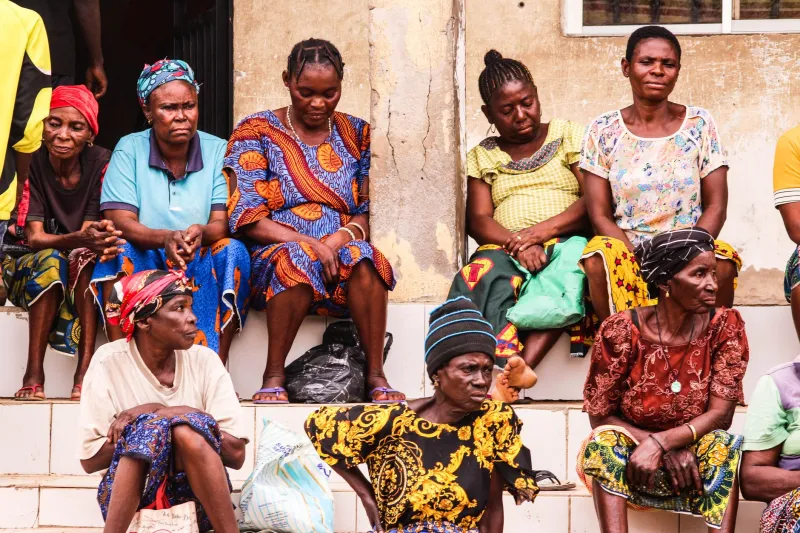
Healing Together: How the African Philosophy of Ubuntu Is Transforming American Mental Health From the Ground Up

In 2023, the U.S. Surgeon General issued an advisory that stopped many Americans in their tracks. Dr. Vivek Murthy declared loneliness a public health epidemic, citing data suggesting that nearly half of all American adults report measurable feelings of isolation. The mental health system, already strained beyond capacity, was ill-equipped to address a crisis rooted not simply in individual pathology but in the very architecture of how Americans relate to one another.
Across the country, a quiet but consequential shift is underway. Progressive therapists, community health workers, and social organizers are increasingly drawing from an African philosophical tradition that has governed communal life for millennia—Ubuntu. Translated most commonly as Umuntu ngumuntu ngabantu, or "I am because we are," Ubuntu encodes a fundamentally relational understanding of personhood. One does not exist fully as a human being in isolation; identity, dignity, and wellness emerge through connection, mutual obligation, and shared belonging.
What began as a philosophical framework is now informing clinical practice, neighborhood-level care models, and policy conversations in cities from Atlanta to Seattle.
A Philosophy With Ancient Roots and Modern Urgency
Ubuntu is not a singular doctrine confined to one ethnic group or region. Variations of the concept appear across dozens of sub-Saharan African cultures, from the Nguni peoples of southern Africa to communities throughout East and West Africa. Scholars of African philosophy, including Mogobe Ramose and Thaddeus Metz, have documented how Ubuntu functions as both an ethical system and a social epistemology—a way of knowing the world through one's relationships rather than through isolated individual cognition.
In traditional African community life, illness—whether physical or psychological—was rarely understood as a purely private matter. A person in distress was understood to be embedded in a web of relationships, and healing required attending to that web. Practices of communal gathering, elder counsel, ritual dialogue, and shared mourning were not supplementary to treatment; they were the treatment.
This stands in sharp contrast to the dominant Western psychiatric model, which locates pathology inside the individual brain and measures recovery through individual symptom reduction. Critics, including many Black and Indigenous mental health professionals in the United States, have long argued that this model is culturally narrow and structurally inadequate—particularly for communities whose suffering is inseparable from histories of collective trauma.
What Neuroscience Is Beginning to Confirm
The emerging science of social neuroscience lends significant weight to Ubuntu's foundational premise. Research from institutions including the University of Chicago and UCLA has demonstrated that chronic loneliness activates the same neural threat-response pathways as physical pain. Conversely, sustained social connection—particularly within communities characterized by trust and mutual care—is associated with measurable reductions in cortisol levels, improved immune function, and greater emotional regulation.
Dr. John Cacioppo, whose pioneering work on loneliness shaped much of this field before his death in 2018, consistently argued that the human nervous system evolved within a social matrix. The brain does not merely benefit from connection—it requires it for baseline regulatory function. Isolation, by this account, is not simply an emotional experience but a physiological stressor.
Ubuntu-informed practitioners point out that African healing traditions arrived at this conclusion empirically, through generations of observing how people thrive and deteriorate, long before the language of neuroscience existed. "Our ancestors were not theorizing," notes one community psychologist working in Chicago's South Side. "They were watching what worked."
Ubuntu in Practice: Community Models Across the United States
A number of organizations are now translating Ubuntu's principles into concrete mental health programming, often in communities that have been systematically underserved by conventional psychiatric care.
In Philadelphia, a community wellness collective rooted in the African diaspora has developed what it calls a "circle care" model, in which small groups of neighbors meet regularly—not as therapy groups in the clinical sense, but as structured communities of accountability and mutual support. Facilitators, many of them trained in both Western counseling methods and African communal traditions, guide participants through practices of storytelling, active listening, and collective problem-solving. Preliminary outcome data suggest meaningful reductions in reported anxiety and depression among participants, alongside increases in what researchers term "social self-efficacy."
In Oakland, California, a mental health cooperative inspired explicitly by Ubuntu principles offers sliding-scale services that integrate individual counseling with mandatory community engagement components. The organization's founders argue that treating mental health as a purely private transaction perpetuates the isolation it is meant to address. Their model insists that healing is relational by nature—that a therapist's office, however skilled the clinician, cannot substitute for the experience of being genuinely known and held by a community.
Across the Southeast, faith communities with deep roots in African and African American traditions have long practiced informal versions of Ubuntu-aligned care—communal prayer, collective mourning, the expectation that members will show up for one another in times of crisis. Mental health professionals are increasingly recognizing these practices not as supplements to "real" treatment but as evidence-based interventions in their own right.
Challenging the Individualism at the Heart of American Psychiatry
Adopting Ubuntu-informed frameworks is not without friction. The American mental health system is deeply structured around individual diagnosis, individual treatment, and individual billing codes. Insurance reimbursement models reward one-on-one clinical encounters; they are ill-suited to compensating community healers, circle facilitators, or the kind of sustained relational presence that Ubuntu demands.
There is also the risk of appropriation—of extracting the aesthetic warmth of communal care while stripping away the cultural and philosophical substance that gives it meaning. African scholars and practitioners have been explicit about this concern. Ubuntu is not a technique to be applied; it is a worldview that requires genuine engagement with African intellectual traditions and, often, with African and Black communities themselves as the primary agents of their own healing.
Progressive mental health advocates argue that taking Ubuntu seriously means more than adding a group therapy session to an otherwise unchanged clinical structure. It means questioning the individualist assumptions embedded in diagnostic categories, reconsidering what counts as expertise, and redistributing resources toward community-based care that centers collective wellbeing.
A Framework America Did Not Invent—But Urgently Needs
The United States has long exported its psychological frameworks to the rest of the world, often with little regard for how those frameworks travel across cultural contexts. The growing interest in Ubuntu-informed care represents something rarer: an American institution—however incrementally—learning from African intellectual heritage rather than presuming to teach it.
For communities already living Ubuntu's principles, this is not a discovery but a recognition. For a country grappling with epidemic loneliness, a fractured care system, and the accumulated psychological weight of racial and economic inequality, it may represent something more urgent: a path toward healing that begins not with the isolated individual, but with the irreducibly human fact of one another.
As the Nguni proverb that anchors this philosophy insists—I am because we are. In that deceptively simple formulation lies a science of human flourishing that American mental health, at its best, is only beginning to understand.