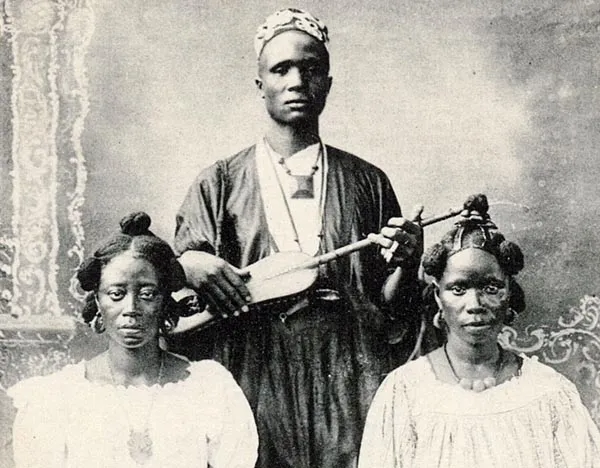
Guardians of the Word: What Silicon Valley Is Learning From Africa's Master Storytellers
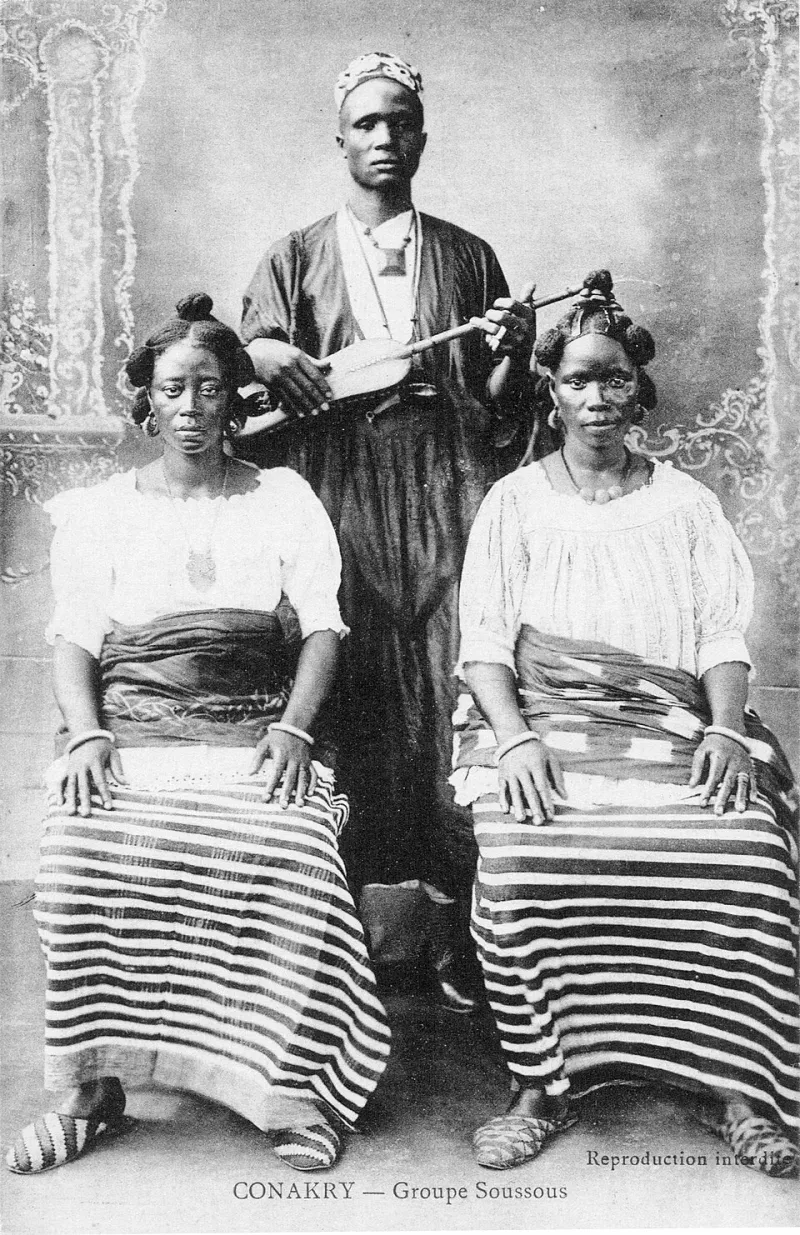
Photo: unknown photographer, c. 1910, Public domain, via Wikimedia Commons
There is a proverb, widely attributed to the Mandinka people of West Africa, that declares: "When an old man dies, a library burns to the ground." For decades, that sentiment was treated in Western academic circles as poetic — a beautiful metaphor for the fragility of human memory. Today, engineers at some of the world's most powerful technology companies are beginning to understand it as something far more literal, and far more instructive.
Across research labs in California, university linguistics departments in Massachusetts, and AI ethics boards from Seattle to Washington, D.C., a quiet but consequential conversation is underway. Its subject: the griot.
Who the Griots Are — and Why They Matter Now
The griot tradition — known as jeli in Mande-speaking communities and gewel among the Wolof — stretches back at least seven centuries across West and Central Africa. Griots are not simply storytellers in the casual sense that word carries in English. They are trained specialists: part historian, part diplomat, part musician, part genealogist. A griot in the court of a Malian ruler was responsible for remembering the names, deeds, and bloodlines of dozens of generations, recalling them on demand with a precision that oral researchers have repeatedly verified against archaeological and written records.
The training process alone is staggering. Young apprentices, often born into griot families, spend years — sometimes decades — absorbing narratives, musical forms, and rhetorical techniques from senior practitioners. The knowledge is not merely memorized but embodied: woven into rhythm, melody, and physical performance so that forgetting becomes structurally difficult. This is not an accident. It is a technology.
And it is precisely that technological dimension that has begun attracting serious institutional attention.
From Oral Courts to AI Training Rooms
In 2022, a coalition of researchers affiliated with several prominent U.S. universities began a formal study examining how griot narrative structures might inform the architecture of large language models — the systems underlying tools like ChatGPT and Google's Gemini. Their central hypothesis was straightforward, if unconventional: that Western text-based training data encodes not just information but a particular logic of knowledge — linear, hierarchical, and heavily dependent on written citation. Griot traditions, by contrast, encode knowledge relationally, contextually, and dynamically.
The implications for AI are not trivial. Systems trained exclusively on written Western sources struggle with what researchers call "contextual drift" — the tendency to strip meaning from its social and historical surroundings. Griot-style transmission, which always situates a fact within a web of relationships and consequences, may offer a structural corrective.
Several technology firms, including at least two major players in the natural language processing space, have quietly begun consulting with griot practitioners and the scholars who study them. The consultations reportedly focus on narrative sequencing, the role of audience response in shaping transmitted knowledge, and the mechanisms by which griots detect and correct distortion across generations — a challenge remarkably analogous to the problem of AI "hallucination."
The Ethical Ledger
For many scholars of African heritage and indigenous knowledge systems, the growing corporate interest in griot traditions inspires as much anxiety as it does hope. The history of Western institutions extracting value from African cultural practices without adequate compensation or attribution is long and largely unresolved. The music industry's relationship with African rhythmic traditions, the pharmaceutical industry's exploitation of botanical knowledge, the art market's treatment of African objects — these are not distant precedents. They are living grievances.
Dr. Aminata Diallo, a Senegalese-American cultural anthropologist based at Howard University, has been among the most articulate voices raising these concerns. "There is a pattern here that we must name directly," she said in a recent public lecture. "When African knowledge systems are recognized, it is almost always at the moment they become useful to someone else's project. The question of what griots and their communities receive in return — not just acknowledgment, but genuine economic and intellectual equity — is not a secondary question. It is the central one."
Those concerns are increasingly being formalized. Several organizations working at the intersection of indigenous rights and digital technology, including groups with strong ties to West African cultural communities in the United States, have begun drafting frameworks for what ethical engagement with griot knowledge might look like. These frameworks typically include requirements for community consent, revenue-sharing arrangements, co-authorship credits in published research, and — crucially — the right of griot communities to withhold or withdraw participation.
Preservation as Partnership
Not all engagements have followed the extractive model. Some collaborations offer a more hopeful template. The Griot Digital Archive Initiative, a joint project between several African universities and diaspora community organizations in the United States, has spent the better part of a decade working with griot families to create audio and video archives of performances — archives that are owned and controlled by the communities themselves, with access governed by protocols the communities designed.
The project's approach is deliberate about what it refuses to do. It does not attempt to convert griot performances into searchable text databases, a process that would strip away the tonal, rhythmic, and gestural information that practitioners consider inseparable from the knowledge itself. It does not publish materials without the explicit consent of the performing families. And it explicitly acknowledges that some knowledge is not meant to be universally accessible — a position that places it in productive tension with the open-access ethos dominant in much of American academic culture.
For American audiences accustomed to thinking of information as inherently public and the internet as inherently democratizing, this posture can feel counterintuitive. But scholars argue that it reflects a sophisticated understanding of how knowledge functions socially. "Griots have always understood that not all knowledge belongs to everyone," notes Dr. Kwame Asante, a digital humanities researcher at the University of Michigan. "That is not secrecy for its own sake. It is an ethical framework for protecting the integrity of what is transmitted."
What the Algorithm Cannot Hold
Perhaps the most important lesson that griot traditions offer to the architects of modern information systems is one that cannot be directly encoded at all. Griot knowledge is alive in a way that databases are not. It responds to its audience, shifts with context, and carries within it the memory of every performance that came before. When a griot recounts the fall of the Mali Empire, they are not retrieving a file. They are re-enacting a living relationship between the past and the present — one that changes, however subtly, with every telling.
No algorithm, however sophisticated, currently replicates that quality. Whether one can be designed to do so is an open and genuinely fascinating question. But the more urgent question — the one that communities, scholars, and policymakers in the United States and across Africa are beginning to press — is whether the attempt should be made at all without the full, informed, and compensated participation of the people who built this knowledge in the first place.
The griots have been preserving civilization for seven hundred years. They deserve more than a consulting fee and a footnote.