Ancient Minds, Modern Archives: How African Oral Traditions Are Revolutionizing Digital Data Preservation
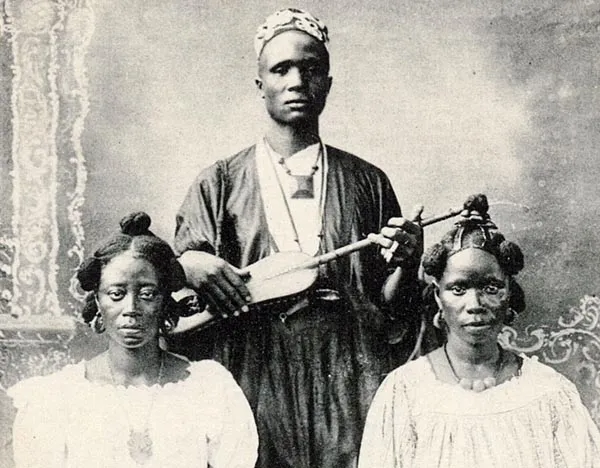
Photo: unknown photographer, c. 1910., Public domain, via Wikimedia Commons
In the server farms humming beneath the Nevada desert and the cloud infrastructure sprawling across data centers from Virginia to Oregon, a quiet crisis is unfolding. Digital storage media degrades. File formats become obsolete. Cybersecurity breaches erase or corrupt irreplaceable records. The institutions entrusted with humanity's most critical information—hospitals, governments, universities, financial systems—are grappling with a fundamental question: How do you preserve knowledge so that it genuinely endures?
The answer, a small but influential community of researchers and technologists now argues, may have existed for thousands of years along the banks of the Niger River, in the highlands of southern Africa, and in the oral courts of West African kingdoms. Africa's tradition-bearers—griots, sangomas, elders, and communal historians—developed information systems of extraordinary sophistication, systems that preserved genealogies, legal codes, medicinal knowledge, astronomical observations, and historical narratives across dozens of generations without a single written character. Today, those systems are quietly informing some of the most innovative thinking in digital archiving, cybersecurity, and human-centered data design.
The Griot's Algorithm
The griot tradition, practiced across a wide swath of West and Central Africa, is perhaps the most extensively studied example of structured oral data management in the world. Griots—known as jeli in Mande-speaking communities and gewel among the Wolof—are not simply storytellers. They are professional archivists, trained from childhood in layered mnemonic systems that encode genealogical records, diplomatic histories, and cultural law within musical phrases, rhythmic patterns, and narrative sequences.
What makes the griot system remarkable from a data science perspective is its redundancy architecture. Critical information is never stored in a single form. A genealogy, for instance, might be embedded simultaneously in a song's melody, its lyrical structure, the specific drum rhythm that accompanies it, and the physical gestures a performer uses during recitation. Each of these layers acts as a backup. If one encoding degrades—if a melody is misremembered or a lyric garbled—the other layers allow for error correction and reconstruction.
Dr. Issiaka Kouyaté, a computational linguist affiliated with the University of Dakar who has collaborated with American research institutions on digital heritage projects, describes this architecture in terms that resonate with modern engineers. "The griot system is, in effect, a distributed storage protocol," he has noted in published research. "Information is sharded across multiple formats and carriers, with built-in checksums that allow a community to detect and correct corruption over time."
This principle—distributing information across redundant, cross-referencing formats—is now being explored by archivists at several American institutions working on long-term digital preservation. The Library of Congress, which has long grappled with the fragility of digital formats, has in recent years invested in research that examines non-Western knowledge preservation systems as models for more resilient archival practice.
Narrative as Encryption
Beyond redundancy, African oral traditions offer another insight that is attracting serious attention in cybersecurity circles: the use of narrative structure as a form of access control.
In many African oral traditions, certain categories of knowledge are encoded within stories that are only fully intelligible to initiated listeners. Among the Yoruba of southwestern Nigeria, for instance, specific oriki—praise poetry traditions—contain embedded genealogical and medicinal knowledge that is structured so that surface-level listeners receive a culturally meaningful narrative, while those with the appropriate cultural and linguistic training can extract deeper layers of specific, technical information.
This layered encoding bears a striking resemblance to the cryptographic concept of steganography—the practice of hiding sensitive data within seemingly ordinary content. Several cybersecurity researchers, including teams at MIT's Media Lab and Georgia Tech's Institute for Information Security & Privacy, have begun examining African oral encoding strategies as inspiration for next-generation steganographic systems that could protect sensitive data by embedding it within culturally rich, human-readable content rather than within purely technical encryption schemes.
The appeal is practical as well as conceptual. Conventional encryption is powerful, but it creates obvious targets: an encrypted file announces that it contains something worth protecting. Narrative-based encoding, by contrast, obscures the very existence of sensitive information within content that appears unremarkable to an uninitiated observer.
The Sangoma's Memory Palace
In southern Africa, the healing and divination traditions associated with sangomas—spiritual practitioners found across Zulu, Xhosa, Ndebele, and related communities—represent a distinct but equally sophisticated approach to knowledge preservation. Sangomas undergo years of intensive training during which they internalize vast pharmacological databases: the properties, interactions, dosages, and preparation methods for hundreds of plant-based medicines, encoded within ritual narratives, symbolic systems, and embodied practices.
The cognitive science underlying this training has attracted significant interest from researchers working on human-computer interaction and knowledge management. The sangoma tradition employs what cognitive scientists call elaborative encoding—linking new information to emotionally resonant, spatially vivid, and narratively structured frameworks that dramatically improve long-term retention and retrieval accuracy. This is, in essence, a highly evolved form of the "memory palace" technique that Western mnemonic practitioners have independently developed, but applied systematically to a professional knowledge domain of extraordinary complexity.
Start-ups in the health informatics sector, particularly those working on clinical decision support systems for under-resourced environments where reliable digital infrastructure cannot be assumed, are beginning to incorporate these principles into their interface design. If a healthcare worker in a rural setting loses connectivity, can the critical information they need be structured in a way that remains cognitively accessible without a screen? African oral knowledge systems suggest that it can.
Preserving the Preservers
There is a profound irony embedded in this story. At the very moment that African oral knowledge systems are attracting serious attention from the global technology community, many of those systems face an existential threat. Urbanization, generational migration, and the overwhelming dominance of digital media are disrupting the apprenticeship structures through which oral traditions have been transmitted for millennia. The griots, sangomas, and oral historians who carry these knowledge systems are aging, and the communities that once sustained intensive oral training are under enormous pressure.
Organizations such as the African Language Research Institute in Zimbabwe and the Mande Studies Association have long sounded the alarm about this erosion. More recently, American digital humanities initiatives—including projects affiliated with the Smithsonian's National Museum of African American History and Culture—have begun collaborative documentation efforts aimed at capturing not just the content of oral traditions but the structural and mnemonic logic that makes them function as information systems.
The stakes, as researchers in this field are quick to point out, extend well beyond cultural preservation in the conventional sense. These are not merely beautiful traditions. They are functional technologies—tested over millennia in conditions of genuine adversity—for solving problems that the digital world has not yet solved.
A Different Kind of Infrastructure
The broader lesson that African oral knowledge systems offer the data science community is perhaps the most challenging one for an industry accustomed to thinking in terms of hardware and code. Resilient information preservation, these traditions suggest, is ultimately a social and relational achievement, not a purely technical one. Knowledge endures not because it is stored in a sufficiently robust medium, but because it is embedded within living communities that have a stake in its survival, the skills to maintain its integrity, and the cultural frameworks to make it meaningful across generations.
As the American technology sector continues to wrestle with questions of data sovereignty, long-term digital preservation, and the human dimensions of information security, the intellectual traditions of Africa's oral knowledge keepers offer something genuinely rare: a proven, scalable, and deeply human-centered model for making critical information last. The memory keepers have been solving this problem for a very long time. The question is whether the digital world is ready to learn from them.