The Discoveries That History Forgot: Ten African Scientific Breakthroughs That Built the Modern World
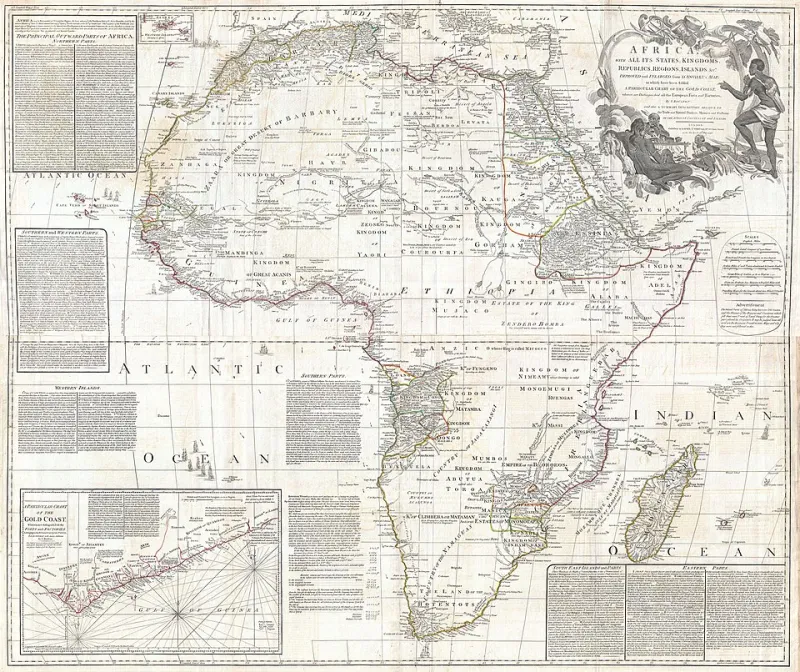
Photo: Solomon Boulton / Jean Baptiste Bourguignon d'Anville, Public domain, via Wikimedia Commons
Every September, millions of American students open new science textbooks. They encounter the expected names — Newton, Darwin, Curie, Einstein — arranged in a familiar lineage that traces the arc of human discovery from ancient Greece through the European Enlightenment and into the modern laboratory. Africa, if it appears at all, is typically rendered as a backdrop for exploration rather than a source of it.
This is a profound distortion of the historical record, and its consequences extend well beyond academic accuracy. When students — particularly Black students — are denied knowledge of African scientific achievement, they are denied a lineage of intellectual belonging. The corrective is not charity; it is honesty. What follows is a necessarily partial account of ten African and African-diaspora scientific contributions that shaped the world Americans live in today.
1. The Mathematical Foundations of Civilization: Ancient Egypt and the Rhind Papyrus
Written approximately 1550 BCE and copied from an even older source, the Rhind Mathematical Papyrus represents one of the earliest systematic treatments of arithmetic, geometry, and algebra in human history. Composed in ancient Egypt — an African civilization — it contains solutions to practical problems involving fractions, area calculations, and volume measurements that would not be matched in sophistication by European mathematical texts for more than a thousand years.
The papyrus is not a curiosity. It is evidence that the mathematical reasoning underlying modern engineering, architecture, and finance has African roots that predate ancient Greece by centuries.
2. The World's First Known Surgery: Trephination in Neolithic Africa
Archaeological evidence from sites across North and East Africa documents the practice of trephination — the surgical removal of sections of the skull — dating back more than 7,000 years. Skulls recovered at these sites show signs of bone regrowth around the incisions, indicating that patients survived the procedures. This represents the earliest documented evidence of intentional surgical intervention in the human archaeological record.
For American medical students taught to locate the origins of surgery in classical antiquity, this evidence demands a fundamental revision of the field's origin story.
3. Inoculation Before Jenner: The West African Origins of Smallpox Vaccination
When Cotton Mather, the Boston Puritan minister, championed the practice of smallpox inoculation during the 1721 epidemic that ravaged New England, he credited his knowledge not to a European physician but to an enslaved African man named Onesimus. Onesimus described a procedure — the deliberate introduction of smallpox material into a healthy person to produce immunity — that was already widely practiced in West Africa.
Edward Jenner is typically celebrated as the father of vaccination, and his contributions were genuine. But the knowledge that made the 1721 Boston inoculation campaign possible — the campaign that is now recognized as a turning point in American public health history — came from an African man whose name most Americans have never encountered.
4. Charles Drew and the Blood Bank: Saving Lives Across a Century
Dr. Charles R. Drew, a Black American physician and surgeon born in Washington, D.C., in 1904, developed the scientific protocols for blood storage and large-scale blood banking that remain foundational to modern medicine. During World War II, his work directly enabled the creation of blood banks that saved tens of thousands of Allied lives.
The bitter irony of Drew's legacy is well documented: the blood banks he helped design were racially segregated by American military policy, separating blood donations by the race of the donor — a practice Drew publicly condemned as scientifically baseless. His story is simultaneously a testament to African-American scientific genius and a case study in how structural racism has historically worked to diminish and distort Black contributions to American life.
5. The Ishango Bone: Africa's 20,000-Year-Old Mathematical Record
Discovered in what is now the Democratic Republic of Congo in 1950, the Ishango Bone is a baboon fibula etched with a series of notches arranged in patterns that many mathematicians and archaeologists interpret as evidence of early numerical notation — and possibly prime number awareness. Dated to approximately 20,000 BCE, it predates any comparable artifact from any other region of the world.
Whether or not the most ambitious interpretations of the bone's markings prove fully persuasive, its existence as a record of systematic numerical thinking in central Africa during the Upper Paleolithic is beyond dispute.
6. Ethiopian Agriculture and the Origins of Coffee
The global coffee industry — valued at more than $100 billion annually and deeply embedded in American daily life — traces its origins to the highlands of Ethiopia, where the Coffea arabica plant was first cultivated and consumed, likely as early as the ninth century CE. Ethiopian farming communities developed the agricultural knowledge and processing techniques that eventually spread through the Arabian Peninsula and into Europe.
Starbucks did not invent morning coffee. Ethiopia did.
7. Imhotep: The First Named Physician in Human History
More than 2,200 years before Hippocrates was born in ancient Greece, an Egyptian polymath named Imhotep was practicing medicine, designing monumental architecture, and composing literary works of sufficient sophistication that later generations would deify him. The Edwin Smith Papyrus, attributed in part to his tradition, describes clinical observations and treatments for injuries with a rationalism that explicitly rejects supernatural causation — a foundational epistemological commitment of modern medicine.
Western medicine's symbolic father is Hippocrates. Its actual forerunner may well be an African man who lived two millennia before him.
8. Philip Emeagwali and the Supercomputer
In 1989, Philip Emeagwali, a Nigerian-born engineer and computer scientist, won the Gordon Bell Prize — the Nobel Prize equivalent in computing — for programming a Connection Machine to perform 3.1 billion calculations per second, a world record at the time. His work on massively parallel computing architectures contributed to the development of the modern internet and to the computational methods used in petroleum reservoir modeling.
Emeagwali's achievement is sometimes celebrated within African and African-American communities but rarely appears in mainstream American accounts of computing history.
9. The African Origins of Iron Smelting
The dominant historical narrative places the origins of iron smelting in the ancient Near East during the second millennium BCE. Archaeological research conducted over the past four decades has complicated that picture considerably. Evidence from sites in Central and West Africa — including the Nok culture in what is now Nigeria — suggests that iron smelting technologies were developed in Africa independently and possibly earlier than previously recognized.
Iron technology is not a footnote in human history. It is the material basis of agricultural expansion, military organization, and the infrastructure of every subsequent civilization. Its African chapters deserve to be read.
10. Wangari Maathai and the Science of Environmental Restoration
Dr. Wangari Maathai of Kenya, the first African woman to receive the Nobel Peace Prize, founded the Green Belt Movement in 1977 — a community-based environmental organization that combined rigorous ecological science with grassroots civic organizing to plant more than 51 million trees across Africa. Her work developed practical methodologies for combating deforestation, soil erosion, and water scarcity that have since been adopted by environmental programs worldwide.
In an era when climate science and environmental policy have become urgent American preoccupations, Maathai's contributions offer both a model and a reminder: the knowledge necessary to address ecological crisis has never been the exclusive property of any single civilization.
Why the Erasure Persists — and What We Can Do About It
The absence of these stories from standard American curricula is not the product of oversight. It reflects deliberate historical choices made during periods when the intellectual and moral inferiority of African peoples was asserted as scientific doctrine — choices whose institutional residue persists in the structure of textbook publishing, standardized testing, and teacher preparation programs.
Correcting this record is not a matter of political concession. It is a matter of scientific and historical integrity. At Kradjabeba, we hold that understanding Africa's contributions to human knowledge is inseparable from understanding human knowledge itself. The cradle of humanity was also, it turns out, the cradle of its ingenuity — and that story belongs to all of us.