Ancient Voices, Living Movements: How African Call-and-Response Is Rewiring American Activism
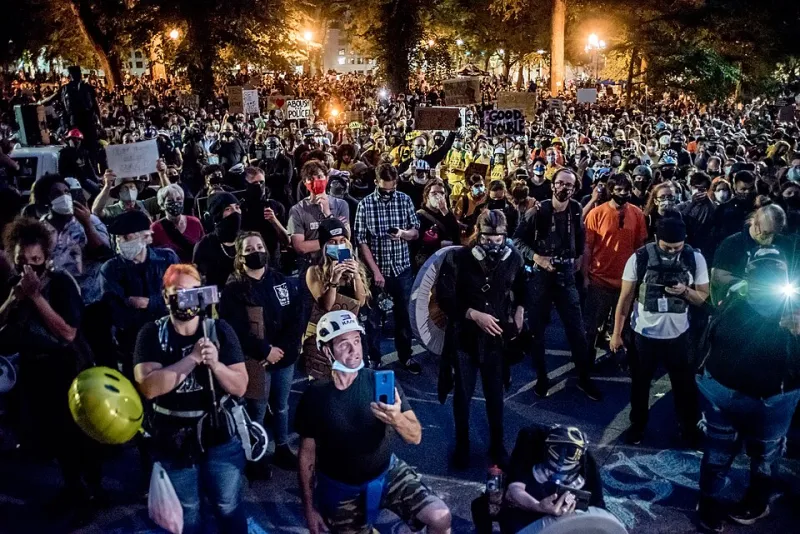
Photo: joyofresistance from USA, Public domain, via Wikimedia Commons
On a sweltering afternoon in Atlanta in the summer of 2020, thousands of demonstrators filled Centennial Olympic Park. A single voice cut through the heat: "Say his name!" The crowd answered in one thunderous wave: "George Floyd!" The exchange repeated, swelled, and transformed a gathering of strangers into something that felt unmistakably ancient — because, in many respects, it was.
Call-and-response is not an invention of the modern protest movement. Its roots stretch deep into the soil of West and Central Africa, where it functioned not merely as musical ornamentation but as a sophisticated technology of social cohesion, collective memory, and participatory governance. Understanding that lineage — and recognizing how contemporary organizers are consciously reclaiming it — offers one of the most compelling windows into how African heritage continues to quietly architect American civic life.
The Architecture of Dialogue
In many West African traditions, the griot occupied a role that defies easy Western translation. Part historian, part diplomat, part community therapist, the griot was above all a facilitator of communal voice. During village assemblies, funeral rites, or moments of political tension, the griot did not simply deliver information to a passive audience. Instead, the communication was inherently iterative: the griot would offer a phrase, a name, a moral claim — and the community would respond, affirm, redirect, or deepen it.
This structure encoded several principles that modern communication theorists are only now beginning to formalize. First, it distributed authority. No single voice held the final word; legitimacy was conferred by the community's response. Second, it created real-time feedback loops, allowing the direction of a gathering to shift organically based on collective emotional and intellectual engagement. Third, it served as a mnemonic device — the repetition and variation of key phrases embedded shared narratives into communal memory far more durably than any written decree.
Across the continent, variations of this framework appeared in Yoruba ijala poetry, Congolese likembe musical traditions, and the call-and-response structures embedded in Akan funeral ceremonies. The form was adaptive, portable, and remarkably resilient — qualities that would prove essential when millions of Africans were violently transported across the Atlantic.
The Middle Passage and the Survival of a Structure
Enslavers could confiscate drums. They could prohibit languages, fracture families, and outlaw assembly. What they could not so easily extinguish was the underlying communicative architecture that those drums had carried. Call-and-response survived the Middle Passage not as a relic but as a living adaptive system, embedding itself into the spirituals of the antebellum South, the ring shouts of the Sea Islands, and eventually the blues, gospel, and jazz traditions that would reshape American culture entirely.
Scholars of African American religious history, including Dr. Sterling Stuckey in his foundational work Slave Culture, have documented how the ring shout — a communal worship practice built entirely on call-and-response dynamics — served simultaneously as spiritual sustenance and as covert political communication. The form was, in other words, always already a tool of resistance.
That dual function never disappeared. It simply evolved.
From the Pulpit to the Pavement
The Black church became the most visible institutional carrier of call-and-response into American public life. During the Civil Rights Movement of the 1950s and 1960s, the tradition moved fluidly from Sunday morning worship into Monday afternoon strategy meetings and Thursday evening marches. The Reverend Dr. Martin Luther King Jr.'s oratory was inseparable from its call-and-response scaffolding — his cadences were calibrated to invite the congregation, whether in a church or on the National Mall, to complete his thoughts aloud. The crowd was never a passive audience. It was a co-author.
What is less frequently examined is how that same structure shaped the organizational culture of groups like the Student Nonviolent Coordinating Committee (SNCC), which deliberately employed participatory meeting formats drawn from Black church tradition to ensure that leadership remained distributed and that grassroots voices shaped strategy. Ella Baker, one of SNCC's most influential architects, was explicit about her distrust of charismatic top-down leadership — a skepticism that aligned, whether consciously or not, with the deeply democratic epistemology embedded in African call-and-response traditions.
Contemporary Organizing and the Deliberate Reclamation
In the years since the Movement for Black Lives gained global visibility, a growing number of organizers have moved from intuitively using call-and-response structures to consciously theorizing them as strategic tools.
In Chicago, the community organizing network Assata's Daughters has incorporated call-and-response frameworks into its leadership development curriculum, training young Black women to facilitate community meetings in ways that prioritize distributed voice and iterative consensus-building. Facilitators describe the approach as both culturally grounding and practically superior to Robert's Rules of Order — the standard Western parliamentary procedure that, as many organizers note, tends to concentrate power in the hands of whoever controls the agenda.
In New York City, the work of groups like Survived and Punished has used chant structures drawn explicitly from African diasporic traditions during courthouse vigils and legislative hearings, deploying call-and-response not only to sustain energy but to signal to participants — many of them incarcerated women's family members with little prior organizing experience — that their voices were structurally central, not decorative.
Dr. Imani Perry, a scholar of African American culture at Harvard, has written about how these traditions encode what she calls "a theory of the subject" — one in which identity and agency are understood as relational and co-constituted rather than isolated and individual. That philosophical underpinning, she argues, makes call-and-response not merely a rhetorical technique but a fundamentally different model of political power.
What the Research Is Beginning to Confirm
Beyond the cultural and political dimensions, emerging research in cognitive science and social psychology is lending empirical weight to what African traditions understood experientially for millennia. Studies on collective effervescence — the phenomenon of shared emotional and physiological synchrony during communal activity — suggest that participatory vocal structures like call-and-response measurably increase group cohesion, individual commitment to collective goals, and the durability of shared identity over time.
Researchers at the University of California, Santa Barbara, studying protest participation and movement retention, have found that gatherings incorporating high levels of participatory vocal engagement produce significantly stronger long-term activist commitment than those structured around passive reception of speeches. The implications for movement strategy are considerable.
A Living Inheritance
It would be a mistake to frame the influence of African call-and-response traditions on American activism as a historical curiosity or a one-directional inheritance. The tradition is not simply something that was brought here and preserved. It is something that continues to evolve, adapt, and teach — generating new forms of community power in real time.
When organizers in Minneapolis, Baltimore, or Los Angeles design meeting structures that rotate facilitation, build in communal affirmation, and use chant to mark transitions between agenda items, they are participating — knowingly or not — in a communicative lineage thousands of years old. When they do so knowingly, with explicit grounding in African heritage, something additional happens: the work becomes an act of cultural reclamation as much as political strategy.
Africa's gift to the American protest tradition is not merely a set of techniques. It is a fundamentally different philosophy of how power should sound — distributed, iterative, and inseparable from the voices of those most affected. In an era when movements are searching urgently for more democratic and sustainable forms of organizing, that philosophy may be among the most consequential inheritances the continent has offered.